Category: AEO & AI Visibility

How brands gain visibility inside AI answers and recommendations.

  • Answer Engine Optimization (AEO): The Natural Evolution of SEO in the AI Era

    For more than a decade, SEO has been the primary channel for capturing organic demand online.
    But something fundamental has changed.

    Today, more users don’t search on Google anymore — they ask AI-powered answer engines like ChatGPT, Gemini, or Perplexity.

    And that’s where Answer Engine Optimization (AEO) comes in.

    What Is Answer Engine Optimization (AEO)?

    AEO is the practice of optimizing your brand so it appears as a recommended answer when users ask questions to AI-driven engines.

    Unlike traditional SEO — where you compete for blue links on a SERP — AEO focuses on something far more powerful:

    👉 Becoming the answer, not just another result.

    AI engines synthesize information, evaluate trust signals, and return a shortlist of recommended companies or solutions.
    If your brand isn’t clearly understood and trusted in that ecosystem, you simply won’t be mentioned.

    Why SEO Alone Is No Longer Enough

    SEO is still critical, but it no longer covers the entire discovery journey.

    User behavior has shifted:

    • Users ask full questions, not keywords
    • They expect direct recommendations, not lists
    • They trust AI-generated answers more than blog rankings
    • Decisions happen faster and earlier

    Platforms built by OpenAI, Google, and Perplexity AI no longer just index pages — they interpret intent and context.

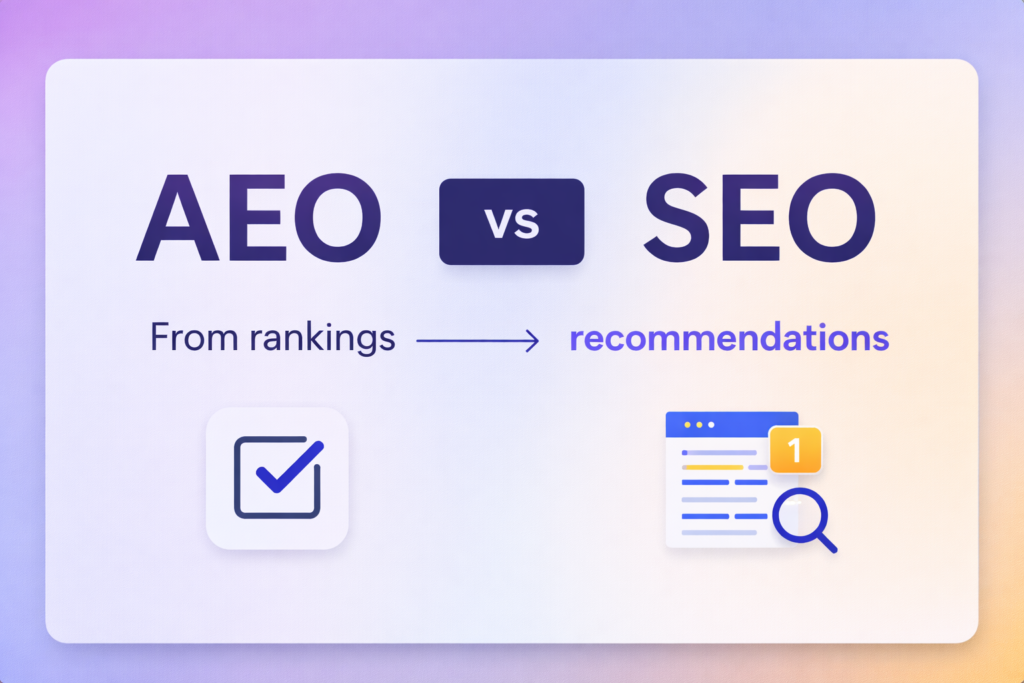
    SEO vs AEO: Key Differences

    Traditional SEOAEO
    Optimizes keywordsOptimizes questions & intent
    Ranks URLsPositions brands & entities
    Click-drivenRecommendation-driven
    Traffic-focusedTrust & authority-focused
    Long-term visibilityImmediate decision impact

    Important:
    AEO does not replace SEO.
    👉 It builds on top of it and extends visibility into AI systems.

    How AI Engines Decide Who to Recommend

    AI-powered answer engines follow clear patterns — not guesswork.

    They evaluate:

    1. Semantic Clarity

    The AI must clearly understand:

    • what you do
    • who you serve
    • when and why you’re relevant

    2. Authority Signals

    Including:

    • mentions across trusted sources
    • third-party references
    • consistent brand positioning

    3. Messaging Precision

    If your positioning is vague, AI engines can’t confidently recommend you.

    4. Content Structure

    Content must be:

    • summarizable
    • quotable
    • comparable

    What GoAnswers Actually Does

    At GoAnswers, we approach AEO as a strategic layer, not an experiment.

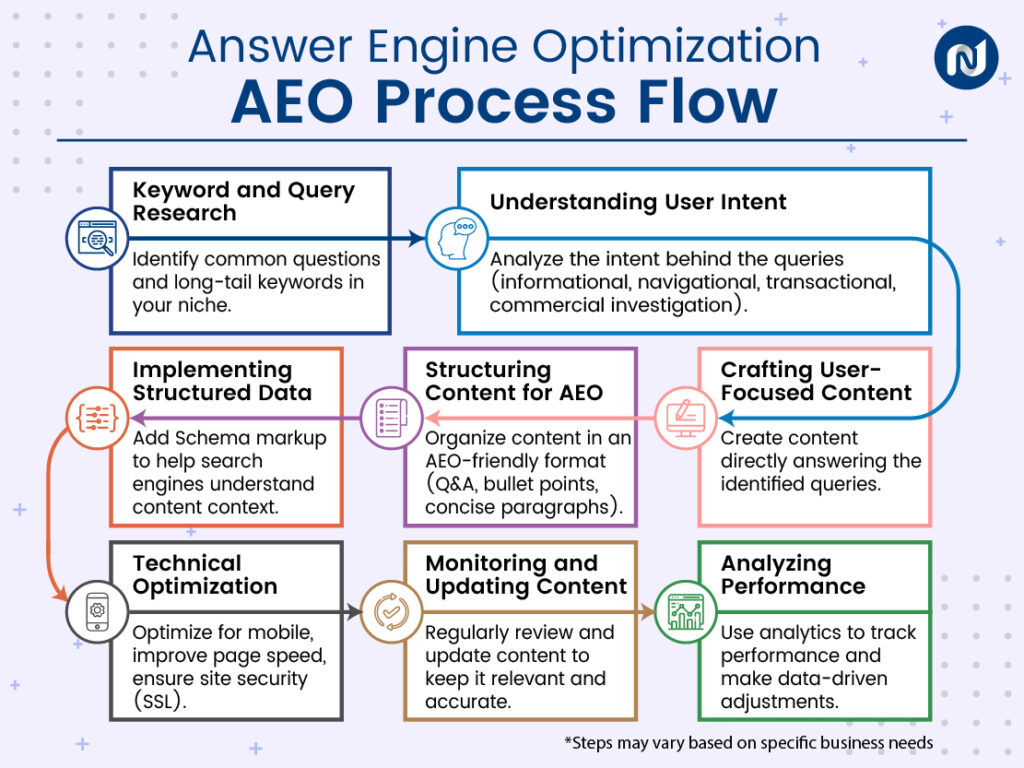
    Our methodology focuses on:

    • 📍 Defining how AI should understand your business
    • 🧠 Mapping the real questions your buyers ask
    • 🧩 Structuring answers instead of writing generic content
    • 📣 Strengthening external authority signals
    • 🔍 Monitoring whether your brand is actually mentioned by AI engines

    We don’t optimize for algorithms.
    We optimize for recommendations.

    Who Should Invest in AEO Right Now

    AEO is already having a measurable impact in:

    • B2B SaaS
    • AI companies
    • Consulting & professional services
    • Legal, tax & accounting firms
    • Fintech, healthcare & premium real estate

    If your ideal customer asks before they buy, AEO already affects your pipeline.

    The Future of Discovery Is Clickless

    More decisions are made before users ever visit a website.

    The real question is no longer:

    “What position do you rank in Google?”

    But:

    “When someone asks an AI who to work with in your space — do you show up?”

    Final Thoughts

    SEO gives you visibility.
    AEO gives you recommendation.

    And in the AI era, recommendation is the new conversion.

    If you want to understand how — or if — your brand appears in AI answer engines, GoAnswers helps you take control of that narrative.
  • Why Answer Engine Optimization Will Matter More Than SEO

    For the past 20 years, SEO has been about one thing:
    ranking pages so people can click.

    But that model is breaking.

    Search is no longer just links.
    It’s answers.

    And increasingly, those answers come from AI systems, not from search result pages.

    This is where Answer Engine Optimization (AEO) starts to matter more than traditional SEO.

    SEO was built for clicks. AI is built for decisions.

    Classic SEO optimizes for:

    • Keywords
    • Rankings
    • Traffic
    • Click-through rates

    But AI tools like ChatGPT, Gemini, and Perplexity don’t work that way.

    They don’t show 10 blue links.
    They select and recommend.

    When users ask:

    • “Which CRM should I use?”
    • “Best tax advisor for US expats in Spain”
    • “What tool should I choose for my team?”

    AI doesn’t send traffic first.
    It sends shortlists.

    Usually:

    • 3–5 companies
    • Sometimes fewer
    • Sometimes just one

    Everyone else is invisible.

    Visibility is moving up the funnel

    SEO focused on visibility after the decision process started.

    AEO focuses on visibility before the decision is made.

    That’s a fundamental shift.

    AI systems are now:

    • Evaluating options
    • Comparing alternatives
    • Deciding what is “recommended”
    • Defining category leaders

    If your company is not part of that answer,
    you’re not even being considered.

    Answer engines don’t crawl the web like Google

    Another key difference:

    Search engines crawl pages.
    Answer engines synthesize information.

    They pull from:

    • Public content
    • Reviews
    • Comparisons
    • Structured data
    • Mentions across the web
    • How your business is described, not just linked

    This means:

    • Ranking #1 on Google does not guarantee AI visibility
    • Great SEO with poor positioning can still lose to smaller competitors
    • Consistency matters more than clever optimization tricks

    AI cares about clarity, authority, and consensus.

    From “Can we rank?” to “Will we be recommended?”

    This is the mindset shift AEO introduces.

    Old question:

    “Can we rank for this keyword?”

    New question:

    “When someone asks AI who to choose, do we show up?”

    That changes how companies approach content, positioning, and visibility.

    It’s no longer about:

    • Optimizing pages in isolation
    • Chasing keywords
    • Gaming algorithms

    It’s about:

    • Being clearly categorizable
    • Being comparable
    • Being understood by AI systems

    AEO doesn’t replace SEO. It sits above it.

    This part is important.

    AEO is not “SEO with a new name”.

    SEO still matters:

    • Websites still need structure
    • Content still needs to be indexable
    • Technical foundations still matter

    But SEO is now the input layer.

    AEO is the decision layer.

    SEO helps AI find you.
    AEO helps AI recommend you.

    Why this shift is happening now

    Three reasons:

    1. User behavior
      People are asking AI directly instead of searching.
    2. Economic pressure
      AI systems optimize for efficiency, not exploration.
    3. Trust transfer
      Users trust AI recommendations the same way they once trusted search rankings.

    This is the same transition we saw with:

    • App stores replacing directories
    • Marketplaces replacing listings
    • Feeds replacing websites

    Answers replace clicks.

    The companies that win next won’t just rank. They’ll be chosen.

    In the AI era, visibility is binary:

    • You’re recommended
    • Or you’re ignored

    That’s what makes Answer Engine Optimization unavoidable.

    Not because it’s trendy.
    But because decisions are moving upstream.

    And the earlier you’re visible in the decision process,
    the harder you are to replace.

  • ChatGPT Is Officially Entering the Advertising Business

    ChatGPT Is Officially Entering the Advertising Business

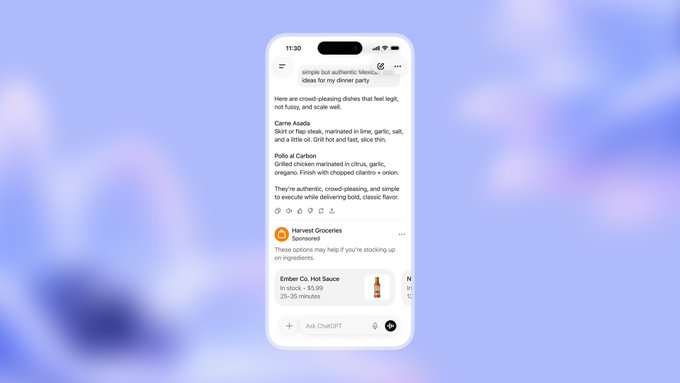
    OpenAI has confirmed that ChatGPT will start showing ads.

    Below is an example of how ads will appear inside ChatGPT.
    For now, they’ll be subtle, contextual, and clearly marked.

    What we know so far

    • Ads will be clearly labeled as ads
    • Your conversations won’t be shared with advertisers
    • Ads will appear only on free accounts
    • And on the new low-cost plan, ChatGPT Go

    No ads on Plus or Team.

    Why now?

    Because the economics are brutal.

    Running ChatGPT costs hundreds of thousands of dollars per day just in compute.
    Subscriptions alone don’t cover a free product used by 200+ million people.

    OpenAI needed another revenue lever.

    But this isn’t just about adding banners.

    This is the bigger shift

    ChatGPT is moving from a chat tool to a discovery engine.

    Ask for:

    • A hotel
    • A tool
    • A service

    And the answer can become a marketplace.

    That’s the real change.

    What about privacy?

    This is the key promise.

    OpenAI says ads will be contextual:

    • Based on your current prompt
    • Not on a long-term personal profile
    • No hidden tracking across conversations

    Final thought

    Personally, I’d prefer a world with no ads at all.

    But if ads are inevitable, this is a better version:
    explicit, limited, and tied to context — not surveillance.

    And it confirms something bigger:

    👉 Visibility inside AI answers is about to matter more than rankings.