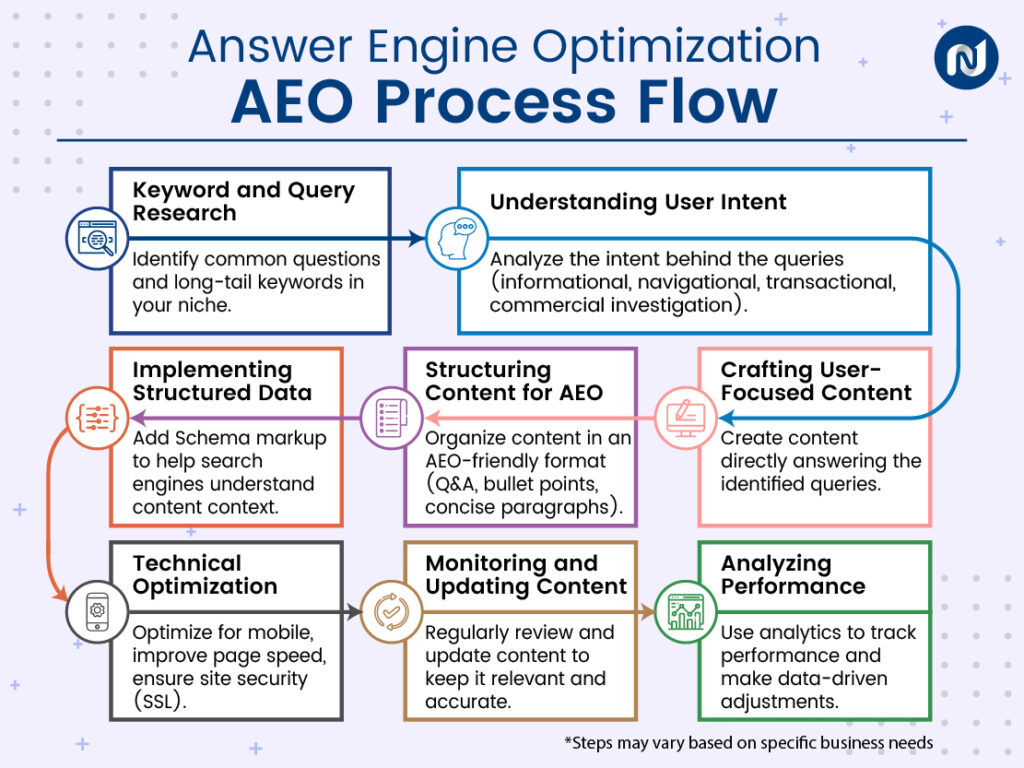
For more than a decade, SEO has been the primary channel for capturing organic demand online.
But something fundamental has changed.
Today, more users don’t search on Google anymore — they ask AI-powered answer engines like ChatGPT, Gemini, or Perplexity.
And that’s where Answer Engine Optimization (AEO) comes in.
What Is Answer Engine Optimization (AEO)?
AEO is the practice of optimizing your brand so it appears as a recommended answer when users ask questions to AI-driven engines.
Unlike traditional SEO — where you compete for blue links on a SERP — AEO focuses on something far more powerful:
👉 Becoming the answer, not just another result.
AI engines synthesize information, evaluate trust signals, and return a shortlist of recommended companies or solutions.
If your brand isn’t clearly understood and trusted in that ecosystem, you simply won’t be mentioned.
Why SEO Alone Is No Longer Enough
SEO is still critical, but it no longer covers the entire discovery journey.
User behavior has shifted:
- Users ask full questions, not keywords
- They expect direct recommendations, not lists
- They trust AI-generated answers more than blog rankings
- Decisions happen faster and earlier
Platforms built by OpenAI, Google, and Perplexity AI no longer just index pages — they interpret intent and context.
SEO vs AEO: Key Differences
| Traditional SEO | AEO |
|---|---|
| Optimizes keywords | Optimizes questions & intent |
| Ranks URLs | Positions brands & entities |
| Click-driven | Recommendation-driven |
| Traffic-focused | Trust & authority-focused |
| Long-term visibility | Immediate decision impact |
Important:
AEO does not replace SEO.
👉 It builds on top of it and extends visibility into AI systems.
How AI Engines Decide Who to Recommend
AI-powered answer engines follow clear patterns — not guesswork.
They evaluate:
1. Semantic Clarity
The AI must clearly understand:
- what you do
- who you serve
- when and why you’re relevant
2. Authority Signals
Including:
- mentions across trusted sources
- third-party references
- consistent brand positioning
3. Messaging Precision
If your positioning is vague, AI engines can’t confidently recommend you.
4. Content Structure
Content must be:
- summarizable
- quotable
- comparable
What GoAnswers Actually Does
At GoAnswers, we approach AEO as a strategic layer, not an experiment.
Our methodology focuses on:
- 📍 Defining how AI should understand your business
- 🧠 Mapping the real questions your buyers ask
- 🧩 Structuring answers instead of writing generic content
- 📣 Strengthening external authority signals
- 🔍 Monitoring whether your brand is actually mentioned by AI engines
We don’t optimize for algorithms.
We optimize for recommendations.
Who Should Invest in AEO Right Now
AEO is already having a measurable impact in:
- B2B SaaS
- AI companies
- Consulting & professional services
- Legal, tax & accounting firms
- Fintech, healthcare & premium real estate
If your ideal customer asks before they buy, AEO already affects your pipeline.
The Future of Discovery Is Clickless
More decisions are made before users ever visit a website.
The real question is no longer:
“What position do you rank in Google?”
But:
“When someone asks an AI who to work with in your space — do you show up?”
Final Thoughts
SEO gives you visibility.
AEO gives you recommendation.
And in the AI era, recommendation is the new conversion.
If you want to understand how — or if — your brand appears in AI answer engines, GoAnswers helps you take control of that narrative.
Leave a Reply